
Soundwalk at Tower Grove Park
December, 2025
by Honna Veerkamp
I'm standing in the wild bird garden at Tower Grove Park. It's 4:30 on a late November day, and it's already getting dark. I'm standing by the fountain, and I mostly hear water sounds. Fresh water ripples over rocks, and I hear each twig snap and leaf rustle under my feet. There are some raucous crows today, and I'm aware that we're still in the city.
I hear a drone of traffic that rises and swells with some squeaky breaks here and there. With the dry leaves and more-exposed trees, the squirrels are noisy too. I hear them wrestling and running through the grass, and their sharp claws scamper on the trees. As I get to the edge of this little woodland, just away from the fountain, water retreats and the traffic from Kinghighway becomes louder. I hear the sound mix change as I turn back the other direction as if someone turned the fountain dial up and the car dial down, but there’s still a background rumble.
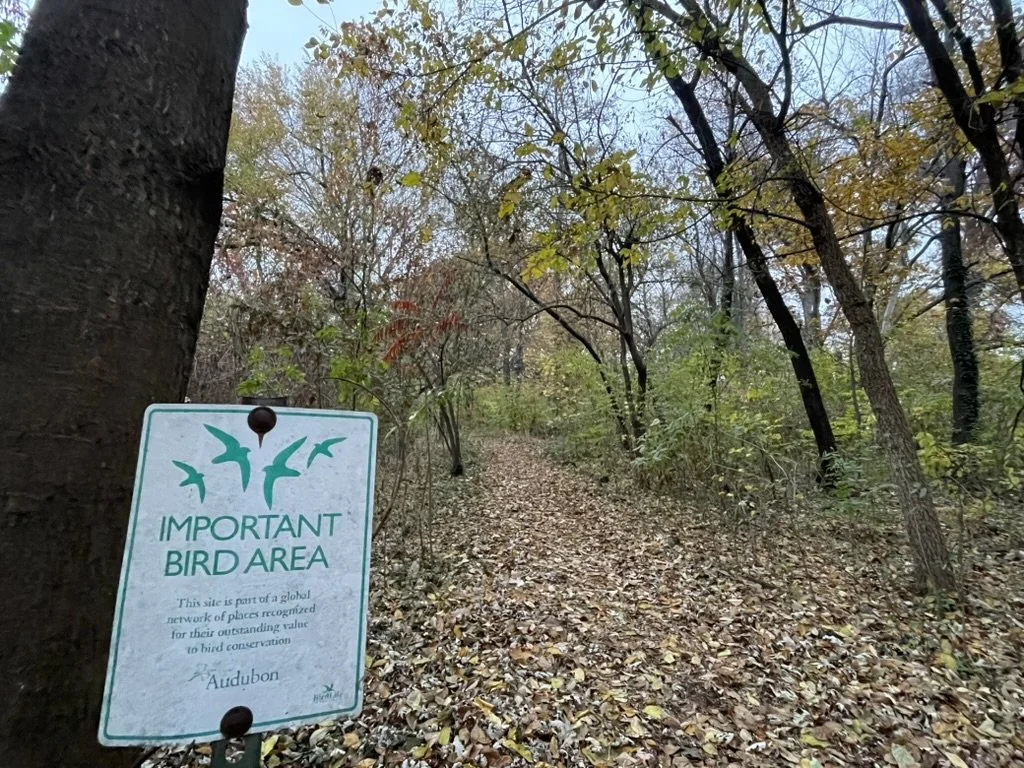
Robert & Martha Gaddy Wild Bird Garden at Tower Grove Park
Soundwalking is the practice of exploring environments with close attention to ambient sounds. Canadian artists and researchers, including composers R. Murray Shaefer and Hildegard Westerkamp developed the practice in the 1970s as part of the World Soundscape Project. They were interested in the idea of harmony between natural and human-made sounds in sonic environments. They incorporated field recordings into musical compositions, and they advocated against noise pollution. Westerkamp later founded the World Forum for Acoustic Ecology, which defines its members as a “multi-disciplinary spectrum of individuals engaged in the study of the social, cultural, and ecological aspects of the sonic environment across the world.”
As I pass the fountain in the other direction, cars and water sounds retreat. I hear the wind shaking the leaves that still are on the trees when I stop for a moment, I hear footsteps of somebody else walking a little ways away. Someone coughs. A car drives by. A jogger passes, talking on their phone. I sit on a bench and listen. A hammering sound asserts itself and sounds like it’s coming from the picnic shelter a little ways off. I stand up and walk towards it.
Another experimental composer, Pauline Oliveros, also influenced my interest in soundwalks. Her philosophies of “sonic awareness” and “deep listening” inspire me to slow down and shift my focus from my most obvious sense purveyor, sight, to the more subtle– and more imaginative– sound. This attention brings different insights.
I’ve led soundwalks with students and artists. I usually choose a site with an interesting mix of sounds. Before we start, we set some ground rules, agreeing to stay quiet and not talk during the walk, so that we can focus on listening. The length of the walk varies, depending on the location. It could be as short as 5 minutes, or it could be a long hike. Before we start, I remind everyone to pay close attention to everything they hear and notice. After the walk, we may sit and write silently before we share. I like to end group walks with an open discussion about what everyone noticed, because people pick up on different things, and it is informative to hear what captured everyone’s attention.
Soundwalking is a great activity for environmental education for all ages, and you can easily adapt the logistics to suit your audience. But you don’t need a group to do a soundwalk. It has great benefits as a form of meditation, and it is a natural compliment to journaling. Sometimes when I am alone, like for this walk, I record voice memos as I listen to the sounds around me. These help me write about my experiences later.
A car passes me, and I hear music with a slight doppler effect as it approaches and continues on. Someone is speaking Spanish as they walk by, their crisp footsteps the drumbeat beneath their lilting voice. Still the hammering sound dominates the soundscape. My heavy boots sync to its rhythm. I sit down again. The steady thump of a runner passes by, and shrill chirps punctuate the cacophony. Merlin says they are white throated sparrows. A gust of wind swooshes around me, and the squirrels shuffle through the leaves.